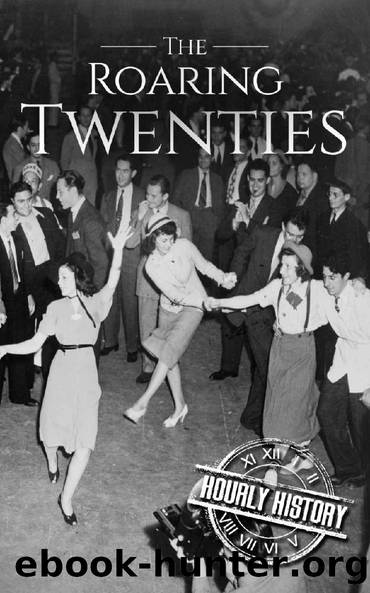
The Roaring Twenties: A History From Beginning to End by Hourly History
Author:Hourly History [History, Hourly]
Language: eng
Format: epub
Publisher: Hourly History
Published: 2017-07-11T00:00:00+00:00
Chapter Three
Womenâs Rights, Civil Rights, and Gay Rights
âThe New Woman of the 1920s boldly asserted her right to dance, drink, smoke, and dateâto work her own property, to live free of the strictures that governed her motherâs generation . . . She flouted Victorian-era conventions and scandalized her parents. In many ways, she controlled her own destiny.â
âJoshua Zeitz
The 1920s was a decade of change in many respects. Along with the technological innovations that spawned modern forms of entertainment, it was a decade of significant social change. Women, in numerous countries throughout the world, won the right to vote, African-American culture drove much of the artistic expression, and homosexuality became more visible, and to some degree, more accepted.
In the United States, the passage of the Nineteenth Amendment in 1920 granted women the right to vote. Other countries around the world did the same, although in some, such as Great Britain, women were not granted full suffrage until 1928. With this change, the mentality about the roles of women also began to shift, particularly in the United States. Prior to the passage of the Nineteenth Amendment, it was commonly believed that women could not pursue both a career and a family. That attitude, however, began to transform as the so-called ânewâ American woman was less interested in social service and more interested in competing and finding personal fulfillment.
At this time in U.S. history, higher education was rapidly expanding to include more women, and that education refuted the belief that men and womenâs social roles were somehow biologically inherent. Co-ed education emerged during this time as women began to attend large state colleges and universities regularly. There were also more employment opportunities for women during this era. World War I had necessitated the use of women in chemical, automobile, iron, and steel manufacturing, but they had been pushed out of those jobs following the war. Despite that fact, the war had shown that women were capable of that type of work, and as demand grew in the booming economy of the 1920s, more opportunities became available for women. Having achieved suffrage, feminists then turned their sights to equal rights. The Equal Rights Amendment was proposed in 1923, and though it did not pass, women were increasingly challenging the traditional roles to which they had been previously relegated.
As the status of women changed, the advertising agencies began to exploit their new-found freedoms. Ads for automobiles began to appear in womenâs magazines and advertisers in general paid more attention to womenâs buying power. Politicians also began focus on issues considered more important to women, including such concerns as childrenâs health.
Young women, in particular, played a significant role in changing traditional views as they promoted the sexual liberation of their generation. The writings of psychoanalysts, such as Sigmund Freud, were key in espousing the idea that sex was central to the human experienceâincluding womenâand that to restrain sexual desires and impulses was self-destructive. These ideas became mainstream during the 1920s, and are reflected in the behavior epitomized by the flapper.
Download
This site does not store any files on its server. We only index and link to content provided by other sites. Please contact the content providers to delete copyright contents if any and email us, we'll remove relevant links or contents immediately.
| Africa | Americas |
| Arctic & Antarctica | Asia |
| Australia & Oceania | Europe |
| Middle East | Russia |
| United States | World |
| Ancient Civilizations | Military |
| Historical Study & Educational Resources |
The Dawn of Everything by David Graeber & David Wengrow(1707)
The Bomber Mafia by Malcolm Gladwell(1622)
Facing the Mountain by Daniel James Brown(1553)
Submerged Prehistory by Benjamin Jonathan; & Clive Bonsall & Catriona Pickard & Anders Fischer(1455)
Wandering in Strange Lands by Morgan Jerkins(1430)
Tip Top by Bill James(1416)
Driving While Brown: Sheriff Joe Arpaio Versus the Latino Resistance by Terry Greene Sterling & Jude Joffe-Block(1376)
Red Roulette : An Insider's Story of Wealth, Power, Corruption, and Vengeance in Today's China (9781982156176) by Shum Desmond(1359)
Evil Geniuses: The Unmaking of America: A Recent History by Kurt Andersen(1353)
The Way of Fire and Ice: The Living Tradition of Norse Paganism by Ryan Smith(1336)
American Kompromat by Craig Unger(1315)
F*cking History by The Captain(1304)
It Was All a Lie by Stuart Stevens;(1300)
American Dreams by Unknown(1286)
Treasure Islands: Tax Havens and the Men who Stole the World by Nicholas Shaxson(1273)
Evil Geniuses by Kurt Andersen(1257)
White House Inc. by Dan Alexander(1212)
The First Conspiracy by Brad Meltzer & Josh Mensch(1174)
The Fifteen Biggest Lies about the Economy: And Everything Else the Right Doesn't Want You to Know about Taxes, Jobs, and Corporate America by Joshua Holland(1126)
